
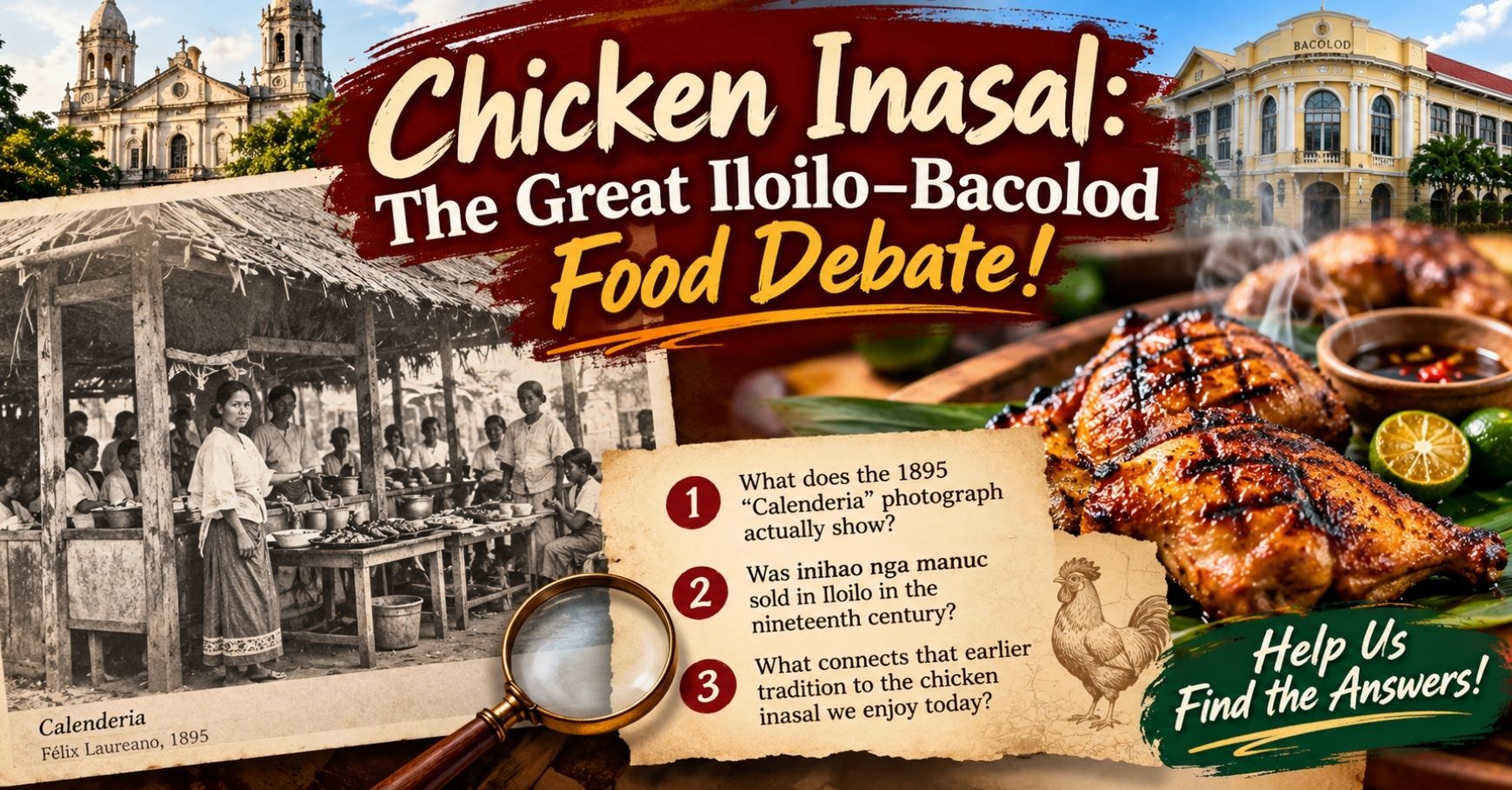
Chicken Inasal: The Great Iloilo–Bacolod Food Debate!
One beloved dish. Two proud cities. And a food-history mystery worth investigating.
Ask an Ilonggo about chicken inasal, and you might hear one version of its history.
Ask a Bacolodnon, and you might hear another.
Both will probably agree on one thing: the chicken must be good!
But ask where the story began, and things get interesting.
Was chicken inasal born in Bacolod? Did it arrive there from Iloilo? Or are we looking at a much longer story about grilled chicken, regional cooking traditions, and the people who made a dish their own?
Well, you know what happens when curiosity gets the better of me.
I start digging.
And this time, I have an AI assistant helping me follow the clues.
A clue from 1895
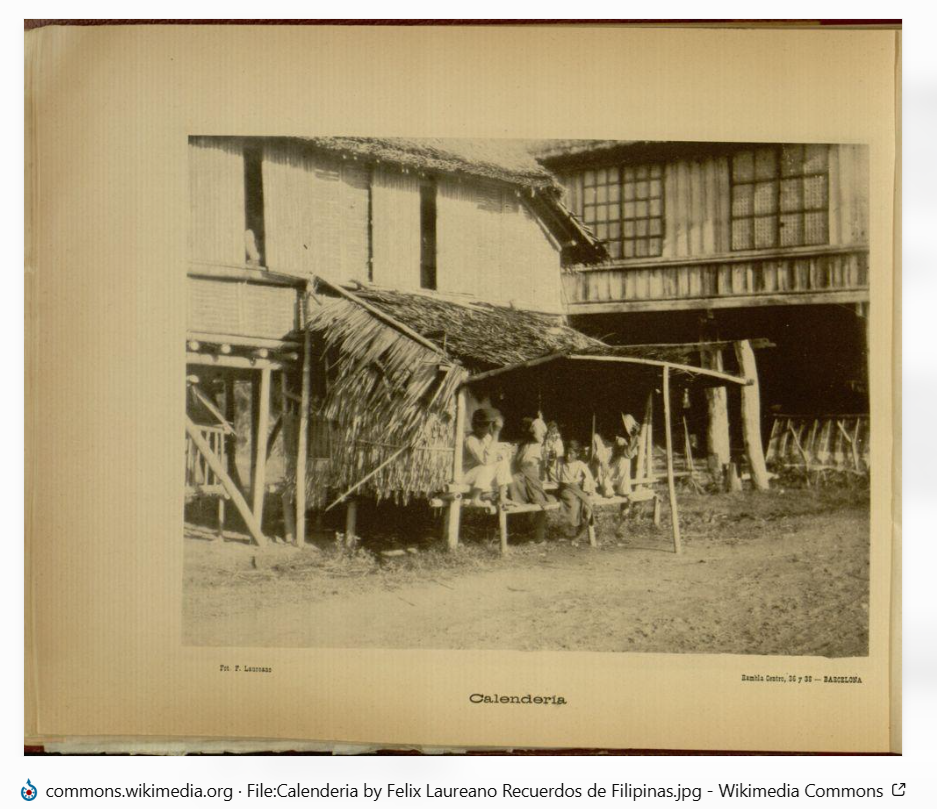
One of the most intriguing leads takes us back to 1895, when Filipino photographer Félix Laureano published Recuerdos de Filipinas, an illustrated work documenting aspects of Philippine life and culture.
Among its sections is Calenderia, which describes a modest roadside establishment selling food, drinks, and everyday provisions to travellers.
And tucked into its food descriptions is a line that caught my attention.
The text reads:
“Tináho nga manok. Pollo asado.”
The Spanish phrase pollo asado means roasted chicken.
I found this line in the original Spanish text, and it gives us a concrete historical clue: Laureano’s work recorded a regional expression associated with roasted chicken in the nineteenth century.
Isn’t that fascinating?
But let’s pause before declaring that we’ve solved the mystery.
The spelling and precise meaning of Tináho still need linguistic verification. More importantly, the passage identifies roasted chicken; it does not provide a recipe or establish that the preparation was identical to the chicken inasal we know today.
Laureano also describes tinola, explaining that it consisted of chicken cooked with fat, water, and ginger, with pieces of white squash added. He calls it an indispensable dish at Filipino dinners.
These descriptions offer a glimpse of the food culture recorded in his work. They do not, on their own, establish the birthplace of modern chicken inasal.
Still, a historical clue is a good place to start.
You can explore the original work through the Villanova Digital Library’s copy of Recuerdos de Filipinas.
And now I have more questions.
What exactly did Laureano mean by Tináho? How was that chicken prepared? Was it cooked over charcoal or by another method? What seasonings were used?
Most importantly, is there documentary evidence connecting this nineteenth-century reference to the dish we call chicken inasal today?
Those questions remain open.
Enter Bacolod, the City of Smiles
Bacolod has embraced chicken inasal as an important part of its cultural identity.
In November 2022, the Bacolod City Government announced that its city council had passed an ordinance declaring chicken inasal a cultural property of Bacolod City.
That is a significant recognition of the dish’s place in the city’s food culture.
And anyone who has experienced the lively atmosphere of a traditional inasal eatery can understand why the dish means more than a meal.
Think of the charcoal grills, the smoky aroma, the familiar flavours, the busy food stalls, and people gathering around tables to enjoy chicken with rice and their favourite sawsawan.
For many Bacolodnons, chicken inasal is part of home, memory, and community.
That cultural connection deserves recognition, regardless of what further historical research may reveal about the dish’s earliest beginnings.
You can read the Bacolod City Government’s announcement about chicken inasal as a cultural property.
Did the story travel between Iloilo and Bacolod?
Here’s where the investigation gets even more interesting.
Accounts of chicken inasal’s development in Bacolod have also pointed to Banoy Velez, reportedly a native of Paklad, Oton, Iloilo, who introduced his inasal business to Bacolod in 1946. Like many Ilonggos of the era who crossed the Guimaras Strait to Negros for commerce and livelihood, he relocated to Bacolod City.
While roasting over hot coals (asal or inasal) has deep pre-colonial roots across the Visayas, Velez is recognized as the pioneer of Bacolod’s street-side, quick-service commercial inasal stall. Cuadra Street subsequently attracted other vendors in the 1970s—earning the moniker “Chicken Alley”—which eventually prompted the local government to establish the famous Manokan Country complex in the early 1980s
This is a lead worth investigating further. We need reliable historical documentation to establish the details of his story and understand precisely what kind of chicken he prepared and sold.
If the account is substantiated, it could help explain how people, cooking practices, and food businesses moved between the two places.
But it would not automatically establish where the dish itself originated.
Food traditions rarely fit neatly inside modern city boundaries. Recipes and techniques can travel with families, cooks, traders, and entrepreneurs. Communities can then adapt them, give them distinctive identities, and make them their own.
Could that be part of the Iloilo–Bacolod story?
It’s certainly a possibility worth exploring.
For now, I would like to see more documentary evidence before drawing a firm conclusion.
And then came the business opportunity
Fast-forward to December 12, 2003.
Edgar “Injap” Sia II opened the first Mang Inasal restaurant at Robinsons Place Iloilo. According to the company’s own history, the business was a tribute to the grill masters who perfected Iloilo’s chicken inasal tradition.
From that first restaurant, Mang Inasal grew into a nationally recognised Filipino brand, bringing its version of the dish to diners across the country.
This is another important part of the story: the transformation of a regional food tradition into a successful national business.
But let’s keep the distinctions clear.
The opening of Mang Inasal in Iloilo documents an important commercial milestone. It does not, by itself, establish the earliest origin of chicken inasal. Likewise, Bacolod’s cultural recognition documents the dish’s importance to that city; it does not settle every historical question about its beginnings.
You can read Mang Inasal’s own account of its history.
So, who gets to claim chicken inasal?
Well, I’m not ready to declare a winner.
What we have so far are several different kinds of evidence:
- A nineteenth-century text that records a regional expression associated with roasted chicken.
- A strong cultural tradition in Bacolod, formally recognised by the city government.
- Historical accounts that may connect Iloilo and Bacolod through the movement of cooks and food businesses.
- The commercial success of Mang Inasal, which helped bring a version of the dish to a much wider audience.
These are important pieces of the puzzle, but they answer different questions.
The nineteenth-century passage does not prove that modern chicken inasal originated in Iloilo. Bacolod’s cultural recognition does not, by itself, establish the dish’s earliest historical origin. And a successful restaurant brand is not the same thing as the origin of a food tradition.
Perhaps the more interesting question is how these stories connect.
A dish can have a long history in one region, develop a distinctive identity in another, and travel far beyond both. Its story can belong to the people who cook it, the communities that preserve it, and the generations who continue to enjoy it.
Because food isn’t just about recipes.
It’s also about people, places, livelihoods, memories, and the ways traditions evolve.
And maybe that’s what makes food history so much fun.
You begin with a plate of grilled chicken and end up exploring the movement of people, the evolution of traditions, and the making of cultural identity.
All because you were hungry!
Help Us Solve the Chicken Inasal Mystery!
Perhaps the most interesting part of this story is that we don’t yet have all the answers.
A photograph published in 1895 offers a tantalising historical clue. Accounts of Iloilo’s food traditions mention inihao nga manuc. Bacolod, meanwhile, has embraced chicken inasal as an important part of its cultural identity.
But how do these pieces of history fit together?
I’d love to hear from historians, archivists, food researchers, cultural workers, and readers who may know something we’ve missed.
Do you know of an original source that explains what Félix Laureano’s Calenderia photograph depicts?
Have you encountered nineteenth-century documents mentioning inihao nga manuc in Iloilo? Or have you come across reliable historical evidence tracing the development of the chicken inasal we enjoy today?
Perhaps you know a researcher, a family with a long history of preparing or selling inasal, or someone who has documented the food traditions of Iloilo or Bacolod.
Please share your knowledge, point us toward reliable sources, or introduce us to people who might help us investigate further.
A family story can be a valuable lead. An old photograph, a newspaper clipping, a passage in a forgotten book, or an archival reference may help us take the next step. Each deserves to be examined in context, and documentary evidence will be especially important in establishing the historical connections we’re looking for.
This isn’t about declaring Iloilo or Bacolod the winner.
It’s about discovering what the evidence can tell us—and preserving the stories that might otherwise be lost.
Because sometimes, the most rewarding part of a food story isn’t finding the final answer.
It’s discovering how much more there is to learn.
Now, it’s your turn!
I’d love to hear from readers in Iloilo, Bacolod, and everywhere else chicken inasal has found a home.
Do you have a historical clue that could help us solve this mystery?
Perhaps your family has an old cookbook, a handwritten recipe, a photograph of an early inasal eatery, or a story passed down by parents and grandparents.
Maybe you know of an old newspaper article, a historical document, or research by someone who has studied the food traditions of Panay and Negros.
I’d especially love to hear from local historians, food researchers, and families whose generations have been preparing or selling inasal.
I’m also looking for help with a few specific questions:
- What can historical and linguistic sources tell us about Laureano’s phrase “Tináho nga manok”?
- Is there reliable documentation supporting the account of Banoy Velez and the development of inasal in Bacolod?
- What evidence can connect nineteenth-century references to roasted chicken with the preparation and identity of modern chicken inasal?
- What do old family recipes and local records tell us about how the dish evolved in Iloilo and Bacolod?
Please share sources wherever possible so we can distinguish documented history from recollection and local tradition.
Let’s collect the memories, follow the evidence, and see what else we can discover.
No need to argue over who wins the title—not yet, anyway!
For now, let’s celebrate the people and communities that have kept this beloved dish alive, while remaining curious about its history.
And who knows? Our next discovery might be hiding in someone’s family recipe book.
Still curious, still wandering.