Why I Write from Memory
By Marie. July 27, 2025

In a world that often demands precision and proof, I find myself returning to something less exact—but perhaps more true: memory.
I write from memory not because it is perfect, but because it glows in places logic forgets and sometimes memories of deep significance insist it be remembered. It flickers in the quiet details—a scent, a glance, the way sunlight broke through the shutters that one morning. Memory holds what mattered, even when the facts have blurred.
I remember Jean
She was—is—a dear friend with a quirky obsession: lighthouses. Not just one or two, but an entire constellation of them scattered throughout her living room. A lighthouse sculpture perched near the window. Cushions printed with lighthouses. Tote bags with distant towers. Shirts from places she hadn't yet visited, each emblazoned with a beacon from another shore.
She loved the way they stood steady. The symbolism, the solitude. Their defiance of storms.
The Lighthouse in Guisi, Guimaras
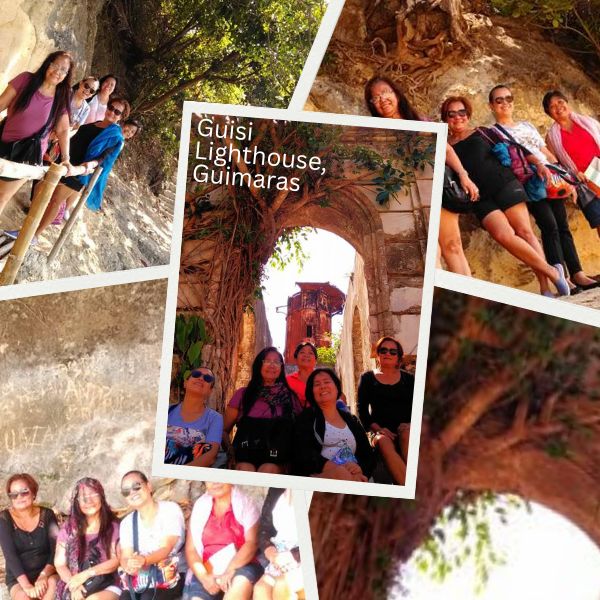
Years ago, my friends and I found ourselves on the Island Province of Guimaras, wandering through a site that time had tried its best to erase—a century-old lighthouse, rusting, resolute. The site was Guisi. It has an 18th century Spanish colonial lighthouse, the second oldest lighthouse in the Philippines. The local government had preserved it like a relic. Its worn spiral staircase made of steel stood the test of time. Taking the steps until the top was prohibited for obvious reason. But the lighthouse still serves its purpose, even up to now. From the beach, Guisi is a beach enclave, we needed to take a low but steep rocky cliff past a narrow and short bamboo bridge, then took a climb to reach the base of the lighthouse. Since taking the steps to the top of the lighthouse was prohibited, we stayed at the landing revealing a wide, wind-struck view of the coast. And standing there, surrounded by the hush of sky and sea, I couldn’t think of anyone but Jean.
I couldn’t explain why.
There was no dramatic conversation or pivotal moment linking her to this particular lighthouse. Only a persistent warmth. A quiet association. The kind memory knows how to keep. Perhaps that’s why I write this way—because my stories rarely come from planned outlines. They come like Jean’s collection: gathered slowly, with affection. Held long enough that they begin to speak.
So, I write from memory
Because in that light, even the ordinary becomes illuminated.
We hadn’t meant to find a lighthouse. What we planned was simpler: a day in Guimaras, fresh mangoes, quiet coastlines, and enough space to breathe again and some fun…
🌴Guimaras: The Pause Between Journeys

The trip to Guimaras was a spontaneous plan. It was March and the weather was perfect for a beach outing. Our former class president suggested we make plans for it. I was usually expected to lead the planning. Upon suggestion of another classmate, Marian, we decided to take a day trip. Looking back, there were six of us - Maribel, Amy, Marian, Mildred, Rosel, and me - who, I guess, took the decision to go the following day pronto! Our main goal was: find the perfect venue for the beach outing.
We boarded a banca at the pier adjacent to where the Rotary Park used to be.
The Iloilo Guimaras Ferry Terminal Today
The Iloilo-Guimaras Ferry Terminal Complex was a Joint Venture project by the City Government of Iloilo, Philippine Port Authority and DoubleDragon Properties Corporation. The complex was redeveloped from the Parola Terminal then into a modern terminal complex with an air-conditioned terminal lobby, ticketing area, canopied loading arcades, public toilets, and designated parking areas and drop-off points. It was constructed adjacent to a public park and a shopping mall owned by Double Dragon to serve the needs of at least 3,500 daily passengers between Iloilo City and the Island Province of Guimaras.
The banca (actually an outrigger) ride to Guimaras never feels like a departure—more like a deep breath. For us Ilonggos, it’s just a short hop across the water. Yet it always feels like a deep breath pulled in after the bustle of Iloilo. The kind you hold onto longer than expected.
In Guimaras, you don’t need grandeur. You need only stillness: the kind that lingers between conversations, between waves lapping the boat’s edge. It’s here, in that pause, that memory settles in—becoming part of the breeze, part of the path leading to the lighthouse we didn’t know would mean so much.
But I remember the late architect Augusto Villalon
.....praising its people and local government for transforming this quiet spot into something remarkable, gently shaping it into an understated retreat. No spectacle. Just sincerity. That validation, coming from someone who fought to preserve Filipino heritage, made me see the island as more than a destination—it was a kind of caretaker.
Augusto Villalon, affectionately known as Toti, was a Yale-educated architect who made a significant impact on the conservation of Philippine heritage. He was instrumental in the inscription of four of the six Philippine sites on the UNESCO World Heritage List and was a founding member of ICOMOS International. Villalon's work included the restoration of the Jai Alai Building in Manila and the documentation of traditional agricultural and cultural landscapes. He was also a founding member of the International Committee on 20th Century Heritage and served on various committees. Villalon's contributions to heritage conservation and his advocacy for the protection of the national patrimony have left a lasting legacy in the field.- UNESCO
Looking back, it feels like Guimaras held a memory like a shell holds sea. Not loudly, not insistently—but with care. Maybe that’s why it kept Jean’s memory alive better than the cities did. The island didn’t demand attention. It simply stayed steady, like the lighthouse we didn’t know would matter so much until it did.