The Digital Artisan: Why Your Messy Process is Your Greatest Protection
If you have watched any of those vertical micro-dramas lately, you know the exact scene. A young, brilliant designer stands in a boardroom, accused of stealing a garment design by a massive, ruthless rival. The rival has the finished dress, the glossy photos, and the slick marketing team.
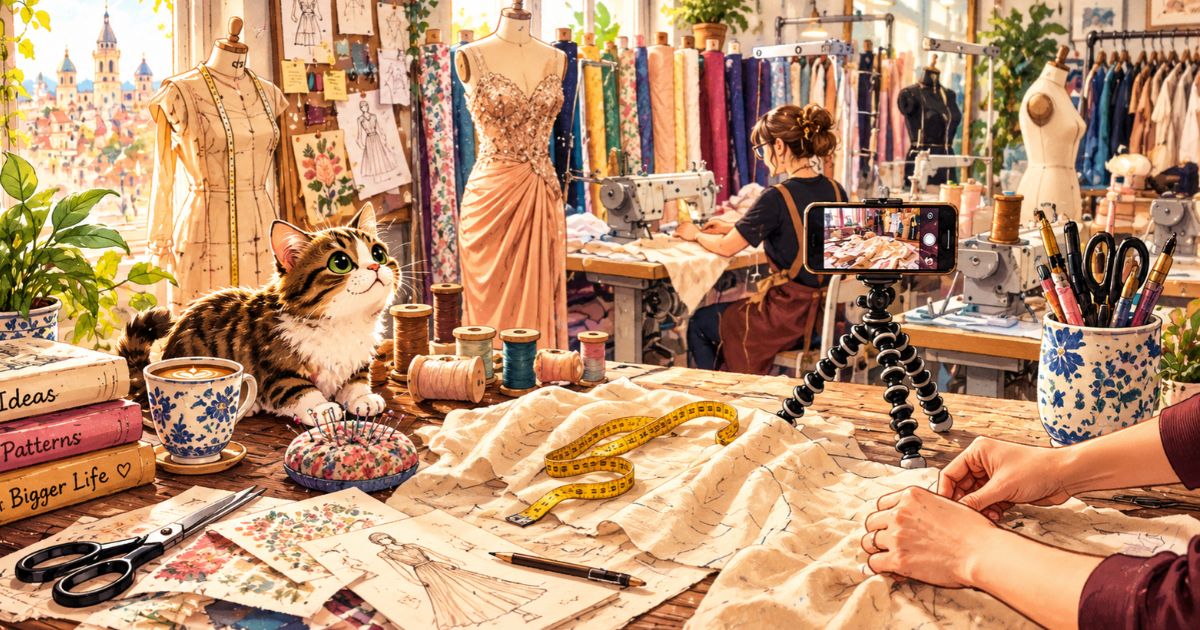
But then, the protagonist pulls out her phone. She doesn’t just show a sketch. She plays a time-stamped video of her draping the raw muslin on a mannequin. She shows the chalk marks, the discarded fabric scraps, and a close-up of her hands threading the intricate beadwork at two in the morning.
In an instant, the rival’s mass-produced lie crumbles. The factory can steal the silhouette, but they can never fake the hours of documented human labor.
It is a satisfying dramatic trope, but for today’s young creatives and aspiring dressmakers, it holds a profound, real-world lesson: your process is your ultimate protection.
I know a master dressmaker whose work rivals the finest haute couturiers in Manila. She operates quietly, known only to a fiercely loyal book of clients who understand that a garment tailored perfectly to their unique posture is worth its weight in gold. She is the ultimate artisan.
Yet, when young designers look at the modern fashion industry, they rarely see a path to become like her. Instead, they feel a crushing pressure to become an assembly line. They are told they must churn out seasonal collections, chase algorithmic trends, and scale their volume at lightning speed just to survive against fast-fashion giants.
It is an exhausting, soul-crushing race to the bottom.
But there is a massive sense of relief available if they embrace the role of the “Digital Artisan.” For a true creator, stepping into the digital age does not mean automating your sewing machine or launching a massive e-commerce warehouse. It means using technology to amplify your bespoke experience and protect your craft.
When you document the story of the stitch — sharing a short, quiet video of your fabric sourcing, the raw chalk lines on a pattern, or the meticulous hand-finishing of a hem — you achieve two critical things.
First, you build an undeniable, time-stamped archive of your intellectual property. You prove your authorship in a way that an AI generator or a fast-fashion factory can never replicate.
Second, you completely redefine your goal line. The digital artisan does not need to sell ten thousand cheap dresses to strangers. By curating a digital gallery of your actual craftsmanship, you use the web to find the exact one hundred loyal patrons who understand the value of an heirloom garment and are willing to pay for it.
You do not have to become a factory to build a successful brand. You just need to be a loud, well-documented artisan. Keep your workroom small, keep your hands on the fabric, and let the digital world witness the beauty of your slow, deliberate craft.
Beyond legal protection, documenting the raw process completely rewires how the world values an artisan’s work, transforming a simple transaction into a lasting legacy. When a dressmaker consistently shares her messy, deliberate reality, several invaluable results begin to emerge.
When you document the story of the stitch, you are doing far more than just creating social media content — you are unlocking invaluable dividends that transform a simple transaction into a lasting legacy. Eventually, when a local filmmaker, a cultural historian, or a journalist discovers this hidden mastery, they will not just find a rack of beautiful dresses, but rather a living, breathing cinematic archive ready to be turned into a profound behind-the-scenes film about a life devoted to craft.
First, it entirely eliminates price resistance. When a client only sees a finished dress on a hanger, they subconsciously compare it to mass-produced alternatives. But when they watch a time-lapse of a master painstakingly adjusting darts to accommodate a unique posture, the conversation about cost vanishes. They realize they are not just purchasing a garment; they are acquiring a piece of your finite time and mastery.
Second, you build a living cultural archive. The tragedy of many hidden masters is that their techniques often retire when they do. By recording your fabric choices and the specific way your scissors glide through a bias cut, you ensure that your analog methods are kept alive for the next generation of creators to study.
Finally, you are unknowingly shooting the footage for your own documentary. All those raw, unedited clips of your messy workbench are cinematic gold. When a filmmaker or historian eventually wants to tell the story of your life’s work, you will not just have finished gowns to show them. You will have a deeply personal, behind-the-scenes short film already waiting to be assembled.
You completely redefine your goal line. The digital artisan does not need to sell ten thousand cheap dresses to strangers. By curating your actual craftsmanship, you use the web to find the exact one hundred loyal patrons who understand the value of an heirloom garment.
You do not have to become a factory to build a successful brand. You just need to be a loud, well-documented artisan. Keep your workroom small, keep your hands on the fabric, and let the digital world witness the beautiful, messy reality of your slow and deliberate craft.