
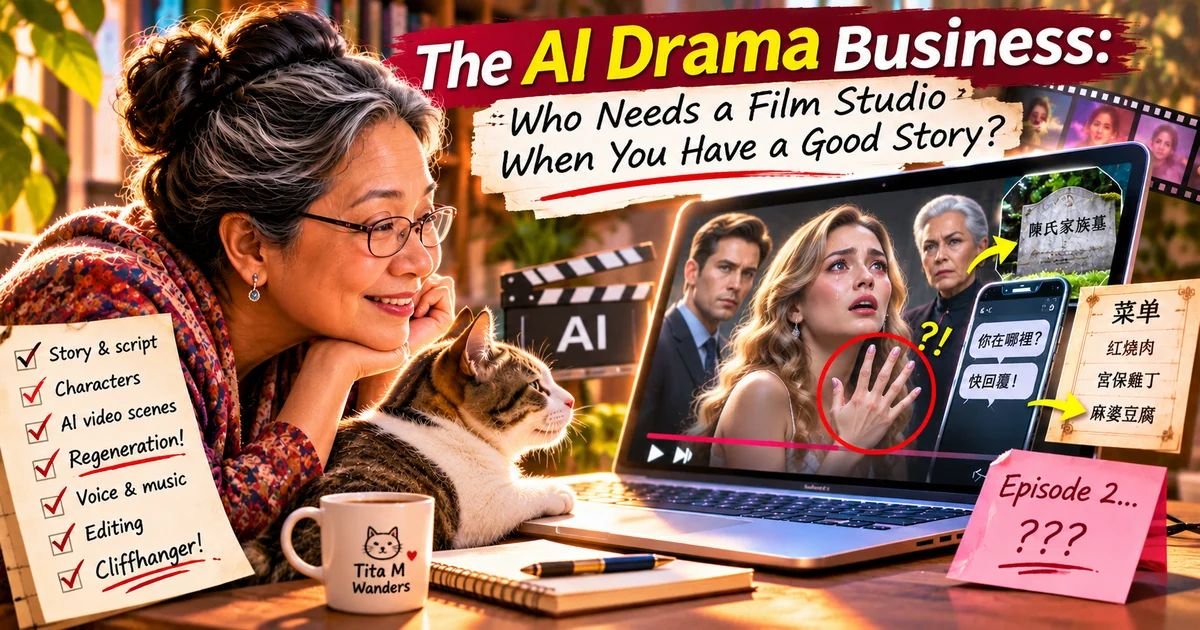
The AI Drama Business: Who Needs a Film Studio When You Have a Good Story?
Have you watched one of those ridiculously dramatic short videos on Facebook lately?
You know the kind.
A woman discovers that her husband has been secretly married to someone else. A poor girl turns out to be the long-lost daughter of a billionaire. A seemingly ordinary housekeeper inherits an entire fortune. And just when you think the story can’t possibly get any more outrageous, somebody reveals another secret.
Then comes the familiar ending:
“But when she opened the envelope, she discovered…”
CUT.
Episode 2.
😂
I used to wonder how people produced these little dramas. Did they have actors? A film crew? A studio somewhere? How much money would it take to make something like this?
Then I started looking into AI-generated short dramas.
And that’s when things got interesting.
It turns out that you don’t necessarily need a film studio, a cast of actors, or even a camera to produce a short dramatic series anymore.
You need a story, a collection of AI tools, a lot of patience, and an audience willing to watch the next episode.
Let’s see how this business works.
So, how are these AI dramas actually made?
Contrary to what we might imagine, making an AI short drama isn’t usually a matter of pressing one button and asking:
“Make me a Filipino teleserye.”
😂
The process is more like assembling a production line.
First, somebody needs a story.
And not just any story. These productions often rely on familiar emotional ingredients: betrayal, revenge, secret identities, family conflicts, impossible love, redemption, and unexpected fortunes.
The story is broken into short episodes, each designed to keep viewers interested.
Next comes character design.
The creators generate reference images for the main characters. This helps them maintain a reasonably consistent appearance throughout the series.
After all, we don’t want our heroine looking like one person in Episode 1 and somebody’s grandmother in Episode 4.
Then comes scene generation.
AI video tools generate short clips based on written prompts. Some of the tools being used in this space include Kling, Runway, Veo, Wan, and MiniMax/Hailuo.
Each clip may last only a few seconds.
A creator might need several clips to tell one short scene, and several scenes to complete an episode.
And then comes the part that people probably underestimate.
Regeneration.
You prompt the AI:
“Woman walks into a restaurant.”
And the AI gives you:
“Woman walks into a restaurant… with six fingers and suddenly becomes somebody’s grandmother.”
😂🤣
You try again.
And again.
And again.
The finished video might last only a minute or two, but getting the right footage can require many attempts.
Once the visuals are ready, creators add voices, dialogue, background music, sound effects, subtitles, and transitions.
Finally, everything is edited into a vertical video, usually in a 9:16 format, ready for mobile viewing.
And, of course, the episode needs a hook.
Something that makes you want to watch the next one.
That cliffhanger isn’t an accident. It’s part of the design.
The surprising economics of making an AI drama
Here’s where I became even more curious.
How much does it cost to produce one of these things?
The AI generation itself can be surprisingly inexpensive compared with traditional video production.
A 2026 analysis by Sincosphere estimated that a ten-episode vertical series, with each episode running 90 seconds, could cost approximately US$70–260 in raw AI model calls if every generated clip worked on the first attempt.
That’s roughly ₱4,000–₱15,000, using an illustrative exchange rate of ₱60 to the dollar.
But there’s a catch.
Those figures cover raw AI generation, not the entire production.
They don’t include the time spent developing the story, writing scripts, creating characters, preparing prompts, regenerating unsatisfactory clips, editing, producing voices, adding music, and preparing the videos for publication.
In other words, the cost of generating the footage isn’t necessarily the cost of producing the show.
And this creates two rather different business possibilities.
The solo creator
One person can take on almost the entire production process.
They develop the story, generate the characters, create the scenes, add voices and music, edit the episodes, and publish them.
The cash expenditure can be relatively modest, depending on the tools and subscriptions used.
But the creator is exchanging money for time and effort.
The small production team
A small team can divide the work among writers, prompt designers, editors, voice artists, and other production specialists.
The AI generation costs may still be relatively low, but the human work adds to the overall budget.
For perspective, one Philippine AI-video production company, Blackbyrds, advertises production packages ranging from approximately ₱20,000 to ₱350,000 or more, depending on the scope of work.
That’s a very different proposition from a solo creator experimenting with AI tools.
And it tells us something important: lower production barriers don’t necessarily eliminate the need for professional skills.
But how do these creators make money?
Now we’re getting to the interesting part.
Surely, nobody is spending hours creating episodes just for the pleasure of watching their characters betray one another.
😂
There are different ways to monetize short-form drama.
One is through social media.
Facebook’s Content Monetization program is performance-based. Meta has increasingly emphasized qualified views, watch time, and meaningful engagement rather than simply counting raw views.
According to Meta’s March 2026 announcement, Facebook paid creators nearly US$3 billion in 2025, with 60% of its total creator payouts going to Reels.
That’s encouraging for video creators.
But it doesn’t mean that a Filipino AI drama receiving one million views automatically earns a particular amount.
Actual earnings depend on several factors, including eligibility, qualified views, audience engagement, and the platform’s monetization rules.
There is another model, however, that I find particularly interesting.
The pay-to-watch model
Some microdrama platforms operate more like subscription or streaming services.
Instead of depending primarily on advertising revenue, they offer viewers access to additional episodes through subscriptions, virtual coins, or other payment arrangements.
For example, Microdrama AI advertises a creator monetization system in which creators receive 70% of revenue attributed to their dramas, including viewing by VIP members and coin-based access.
The business model is quite different:
Create a story → Release episodes → End with a cliffhanger → Encourage viewers to unlock the next episode → Earn from viewing.
Think about that for a moment.
The creator isn’t simply trying to attract views. The creator is trying to persuade viewers to pay to discover what happens next.
And that changes the economics of storytelling.
Why the Philippines could be an interesting market
Now, I couldn’t help thinking about the Philippines.
We already have a long relationship with serialized drama.
Teleseryes, romance, family conflicts, revenge, impossible love, social-class differences, secret identities, and tearjerkers are hardly unfamiliar territory.
We have audiences who enjoy following characters through complicated relationships and seemingly endless twists.
😂
AI makes it possible for more people to experiment with producing these stories without having to assemble a traditional film crew.
You don’t need the same level of investment in cameras, lighting, locations, costumes, actors, and production facilities.
Instead, you need a compelling story, a workable production process, consistent characters, editing skills, and a way to reach an audience.
That doesn’t mean making a successful drama is easy. It simply means that some of the barriers to getting started have changed.
And this isn’t just speculation.
China is already demonstrating how quickly the format can grow. A September 2026 Reuters report reported that more than 221,900 AI shows launched on Douyin during the first half of 2026.
But here’s the detail I find particularly important: only a small fraction gained significant traction.
So, while AI may make it easier to produce a show, it doesn’t guarantee that anyone will watch it.
The real business may not be in making the videos
This is where I think things get especially interesting.
If AI can make video production more accessible, what happens to the business opportunities surrounding it?
Perhaps some people will become independent AI-drama creators.
Others might specialize in scriptwriting, character development, storyboarding, voice production, editing, or managing entire microdrama projects for clients.
Some may develop original stories and license them to production teams or platforms.
And others might focus on distribution and audience development.
In other words, the opportunity isn’t necessarily limited to producing dramas.
It could extend to the entire ecosystem that makes these productions possible.
But there’s one thing AI cannot guarantee.
A good story.
It can help generate scenes, create characters, produce voices, and assemble visual sequences. It can even suggest plot twists.
But getting people emotionally invested in a character, making them care about what happens next, and persuading them to return for another episode remains a creative challenge.
And perhaps that’s the most interesting part of this whole exploration.
Making the drama is getting cheaper. Getting people to watch it is still hard.
So, the next time you find yourself watching a short drama on Facebook, remember that behind those few minutes of betrayal, romance, revenge, and improbable inheritances may be an entire little production operation.
And somewhere behind it might be one person with a laptop, a collection of AI tools, and a rather dramatic imagination.
Who knows?
Perhaps the next big teleserye creator won’t need a television network or a film studio.
Perhaps all they need is a good story.
And a very convincing cliffhanger.
😂
Curiosity often leads us somewhere unexpected. This time, it led us behind the scenes of a new kind of storytelling business.