
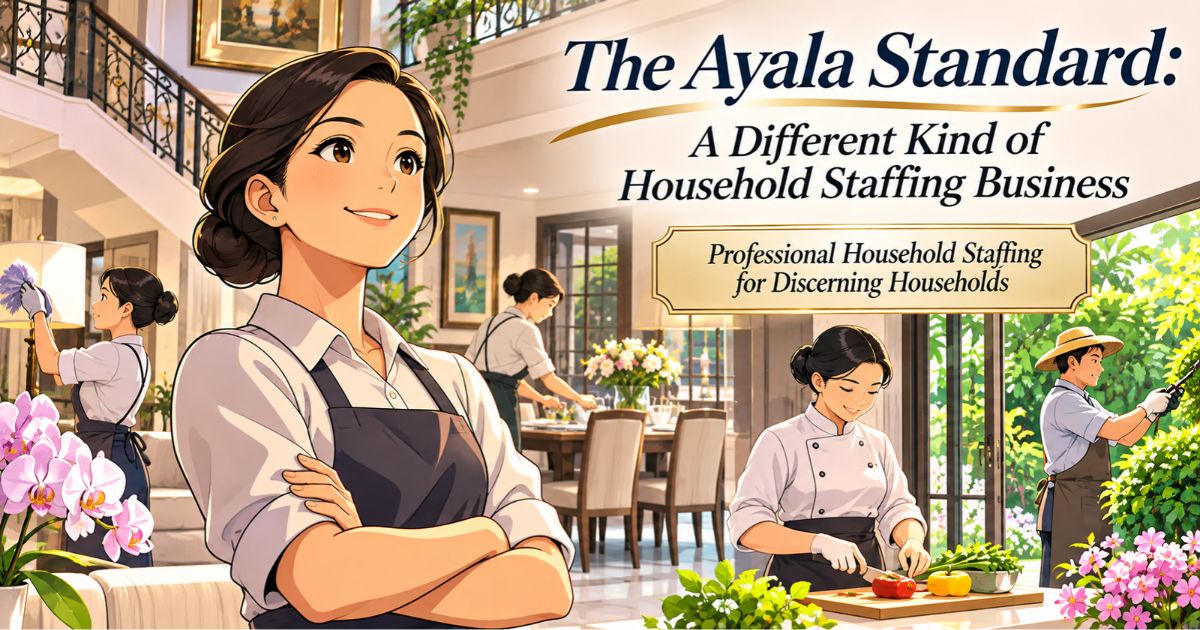
The Ayala Standard: A Different Kind of Household Staffing Business
There was a joke that made the rounds among newly affluent Filipinos some years ago.
If you were going to hire a housekeeper, you might as well hire someone who knew how the Ayalas kept house.
It was a cheeky remark, but it hinted at something interesting. As more Filipino families acquired larger homes, busier lifestyles, and greater expectations of domestic comfort, some began looking beyond the traditional idea of household help.
They didn’t simply want someone to clean the house. They wanted someone who understood how to maintain a well-managed household.
And that brings us to an intriguing business question:
What if there were a specialist staffing company that connected discerning households with experienced household professionals, including returning Filipinos who had developed their skills while working overseas?
Not just another domestic staffing agency, but a business built around professional competence, carefully assessed experience, and the art of running a household exceptionally well.
The Experience That Inspired the Idea
Consider a story from the late 1990s.
A Filipina who had worked as a domestic helper for a very affluent family in Hong Kong returned home. She was college-educated, articulate, conscientious, and kind. She had also acquired considerable experience managing the demands of a sophisticated household.
Back in the Philippines, she initially looked for a teaching position but couldn’t find one. Eventually, she accepted a three-month household job with a family in Forbes Park.
During her interview, she described the responsibilities she had handled overseas. Her prospective employer was impressed. When asked about her salary expectations, she mentioned that she had been earning the equivalent of approximately ₱50,000 a month in Hong Kong.
She was hired at that rate.
She wasn’t even required to live in.
Of course, her overseas experience wasn’t the only reason she got the job. Her education, intelligence, communication skills, work ethic, and personal qualities mattered, too.
But the story illustrates an important point: there are employers who recognize the value of a household professional’s experience and are willing to pay accordingly.
The challenge is finding the right people and bringing them together.
The Business Opportunity: Household Excellence
Let’s call the proposed business Household Excellence.
Its positioning would be simple:
Professional household staffing for discerning households.
Rather than competing with ordinary domestic staffing agencies on volume or price, Household Excellence would specialize in recruiting, assessing, and matching people with the skills and experience to perform more demanding household responsibilities.
Its potential clients could include:
- Affluent families with large or complex households.
- Dual-career couples who need reliable household management.
- Families with elderly members or young children who require additional household support.
- Executives and professionals who value discretion, consistency, and well-organized domestic operations.
- Families with multiple properties or residences that need coordinated household services.
The emphasis would not be on a prestigious overseas employer’s name. It would be on what the candidate actually knows and can do.
Not Just Housekeepers: A Different Set of Roles
A well-run household involves more than cleaning and cooking. Depending on its size and the family’s needs, it can require several specialized functions.
Household Excellence could develop a roster of candidates for roles such as:
1. Household Manager
Oversees day-to-day household operations, coordinates other household staff, manages inventories and supplies, and ensures that routines are followed.
2. Senior Housekeeper
Maintains high standards of cleanliness, organization, and care for household furnishings, fixtures, and personal belongings.
3. Household Cook
Prepares daily meals, plans menus, manages kitchen inventories, and understands food safety and different dietary requirements.
4. Laundry and Wardrobe Specialist
Handles garment care, fabric-specific washing and pressing, wardrobe organization, and the maintenance of delicate clothing.
5. Family Assistant
Provides practical support with household schedules, errands, appointments, and coordination of everyday family requirements.
6. Gardening and Grounds Specialist
Maintains gardens, indoor plants, outdoor spaces, and the general appearance of the property’s grounds.
These would be specialized job profiles rather than simply different labels for the same domestic-worker position. Each would have its own competency requirements, responsibilities, and compensation expectations.
What Would Make Household Excellence Different?
The real product isn’t a list of available workers.
It’s the assurance that candidates have been properly assessed and matched to the requirements of a particular household.
The company could distinguish itself through several services:
Competency-based recruitment
Candidates would be evaluated on actual skills, work experience, reliability, communication, and ability to perform the responsibilities of the position.
Professional candidate profiles
Instead of a basic biodata sheet, each candidate would have a structured professional profile describing previous responsibilities, demonstrated competencies, relevant training, and verified references.
Employer-specific matching
A household looking for someone to manage supplies and coordinate staff has different requirements from one seeking an experienced cook or senior housekeeper. Matching would consider the actual needs of the employer.
Employment facilitation
The company would help both parties clarify duties, working arrangements, compensation, schedules, and expectations before employment begins.
Post-placement support
A placement shouldn’t be considered successful simply because a candidate has been hired. Follow-up, feedback, and assistance in resolving misunderstandings could help build longer-lasting working relationships.
Over time, the company could also offer skills assessments and additional training to help candidates advance into more specialized roles.
Where Would the Talent Come From?
Returning overseas Filipino workers could be an important source of candidates.
Many have worked in households with demanding standards, acquired specialized skills, and learned to operate independently in unfamiliar environments. Some have experience with household inventories, food preparation, childcare routines, gardening, laundry management, and coordinating household staff.
But the recruitment pool shouldn’t be limited to returning OFWs.
There are also Filipinos who have developed comparable expertise through years of local employment, formal training, or experience working in well-managed households.
The principle should be straightforward: competence matters more than where someone acquired it.
Household Excellence would identify people with demonstrable skills and give them access to employers who appreciate those capabilities.
How Could the Business Make Money?
There are several possible revenue streams:
- Placement fees: Employers pay for successful recruitment and placement, subject to applicable regulations.
- Ongoing staffing services: Employers subscribe to assistance with replacement recruitment, staffing coordination, and other agreed services.
- Training and assessment: Households or institutional clients engage the company to assess or train household personnel.
- Specialized household support: The business could eventually expand into household operations consulting or managed staffing services.
The business would need to establish a transparent fee structure and ensure that recruitment practices comply with applicable Philippine laws. Protecting workers from exploitative recruitment fees and misleading employment promises should be part of its operating principles from the beginning.
The Challenges We Shouldn’t Ignore
A premium positioning doesn’t automatically guarantee a profitable business.
Before launching, an entrepreneur would need to establish whether there are enough households willing to pay for this specialized service.
Some important questions need answers:
- How many households are actually looking for professionally assessed household personnel?
- What roles are most difficult for them to fill?
- What compensation are they prepared to offer?
- How many qualified candidates are available?
- What would persuade an employer to use a specialist agency rather than rely on personal referrals?
- How can the company verify overseas employment histories and references?
- What licensing, employment, and placement requirements apply?
There is also the challenge of trust. Household employment is personal. Employers are allowing someone into their private lives, while workers are entering an environment where their rights, safety, and dignity must be respected.
A successful company would have to earn the confidence of both sides.
A Business That Could Give Experience a New Value
What makes this idea particularly interesting is that it addresses two needs at the same time.
On one side are households looking for dependable, competent people who can help them maintain a well-organized home.
On the other are experienced Filipinos returning from overseas, bringing knowledge and practical skills that may not be fully recognized in the local employment market.
The opportunity lies in connecting the two.
Perhaps the next step in household staffing isn’t simply finding someone to do the work.
Perhaps it’s recognizing that running a household well is a skill in itself — one that requires experience, judgment, organization, and professionalism.
And perhaps there are employers willing to pay for exactly that.
The Ayala Standard may have started as a joke. But the business opportunity behind it deserves a serious look.