The Strange Usefulness of Old Skills
Every now and then, someone asks me how I manage to keep working after retiring from employment.
“How do you do it?”
The short answer is: experience.
I’ve been doing things for a long time.
After leaving employment, I built static websites for two non-profit organizations. I did market research on wastewater management for a British company and an Irish company. I provided business services to a law office for more than ten years—long before anyone was talking about virtual assistants and remote work the way we do today.
I eventually realized that I wasn’t starting from scratch at all.
I was simply using things I had learned along the way.
And that made me think about something I had been doing almost all my life:
I never really stopped learning.
I didn’t know what I was collecting.
My formal education wasn’t particularly designed to prepare me for the work I would eventually do.
But somewhere along the way, I discovered journalism.
My main elective in high school was journalism. In college, I became an associate editor of our university magazine and newspaper. Those were exciting years for college journalism—we were fortunate to be part of a publication that won almost all of the major regional journalism awards at the time.
I didn’t know then that journalism would follow me into other parts of my life.
It taught me to ask questions.
To listen.
To look for the story.
To write clearly.
To distinguish what matters from what doesn’t.
Those turned out to be useful skills.
Very useful.
Then came work.
I learned sales.
I learned marketing.
I learned how businesses operate and how people make decisions.
I worked for a multinational company that had its own university for employees around the world. We had short courses taught by professors and specialists from the company’s headquarters in the United States and from its Japanese partner companies.
At one point, when I considered taking an MBA, a former boss—who had by then become dean of the Entrepreneurship School at the University of Asia & the Pacific—actually talked me out of it.
His argument was essentially: You’ve already had a lot of this training.
He had a point.
I had never thought of those courses as an education I was “collecting.”
I was simply learning what was available to me.
And I kept doing it.
When I could afford it, I took art classes.
I studied creative writing.
I kept writing.
I learned more about sales and marketing.
Later, I learned how to build websites.
I learned how to conduct research for clients.
And much later still, when technology changed again, I started learning about AI.
Recently, I became curious about video creation.
Which is how I eventually found myself sitting in front of Canva, trying to figure out how to make a pair of shoes slowly move across a screen. 😂
At this point, I suppose I should admit that I am still very much a student.
The strange thing about learning
Here’s what fascinates me.
You rarely know when something you’ve learned will become useful.
When I was studying journalism, I wasn’t thinking:
One day, this will help me build websites.
When I took creative writing, I wasn’t thinking:
This will someday help me write for the internet.
When I learned sales and marketing, I certainly wasn’t thinking:
Decades from now, I might be doing freelance work from my own home.
And when I started learning about websites, I wasn’t imagining that one day I’d be using AI to help me create content—or that I’d become curious about turning my writing into little videos.
The connections only become visible afterward.
One skill quietly meets another.
One experience gives meaning to something you learned years earlier.
Something you thought was completely unrelated suddenly becomes useful.
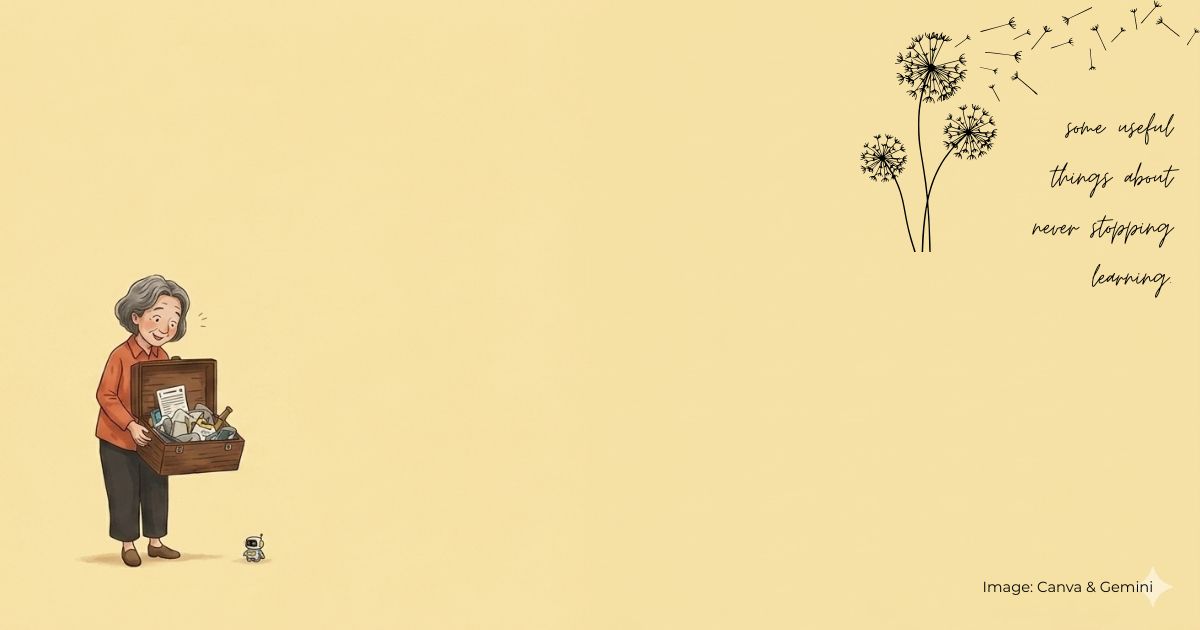
It’s rather like having a very strange toolbox.
You keep putting things into it.
You don’t always know why.
Then one day, something needs fixing.
You open the toolbox and think:
“Oh. I have something for this.”
So learn from wherever you are
This is something I used to tell the people who worked with me:
Learn as much as you can from the company you’re working for.
Don’t just do your job.
Learn how the business works.
Learn from your bosses.
Learn from your colleagues.
Learn from your customers.
Learn how problems are solved.
Learn how decisions are made.
Learn what works.
Learn what doesn’t.
And then keep learning beyond the job.
Because your employer may be paying you for the work you do today.
But the knowledge you take with you belongs to you.
And you have no idea when you will need it.
You don’t have to know what it will become
I think this is particularly important when you’re young.
There is so much pressure to figure everything out.
What career?
What industry?
What job?
What specialization?
What will make you successful?
But perhaps we don’t always have to know.
Perhaps sometimes it’s enough to be curious.
Learn something because it interests you.
Take the course.
Try the unfamiliar thing.
Read about something outside your field.
Talk to someone who knows more than you.
Learn a skill that seems completely unrelated to what you’re doing now.
You don’t have to know where it will lead.
You are building a collection of possibilities.
Years from now, some of those things may turn out to be surprisingly useful.
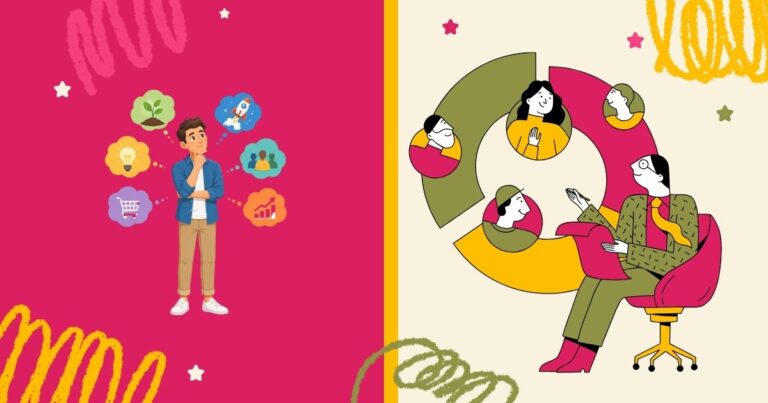
Looking back, I realize that my career was not one straight line.
It was more like a collection of seemingly unrelated roads:
high school journalism → writing → communication → sales → marketing → business → research → websites → AI → video.
At the time, they didn’t look connected.
Now they do.
And perhaps that’s one of the nice things about getting older.
You begin to see connections that weren’t visible when you were busy living the individual moments.
You realize that very little of what you genuinely learn is ever completely wasted.
Some lessons simply have to wait for their moment.
So if you’re somewhere in your twenties or thirties and you’re wondering whether something you’re learning now will ever matter—
keep learning.
You may not need it tomorrow.
You may not need it next year.
You may not even remember learning it ten years from now.
But one day, you may open that strange old toolbox and say:
“Oh. I have something for this.”
And that, I’ve discovered, is one of the most useful things about never stopping learning.