The Studio Without Walls: A New Business in Commercial Representation
What if talented producers didn’t have to become marketers, salespeople and business developers just to make a living from what they do best?
I recently came across the Instagram page of DF Art Agency, a Philippine art representation agency.
I’m no art connoisseur. I just trust my eyes. 😂 But I found the artworks and the contemporary artists they represent quite outstanding.
And it got me thinking.
Behind every talented artist, artisan, designer or independent producer, there is a commercial challenge that doesn’t always get the attention it deserves.
Creating something good and selling it successfully are two very different skills.
An artist may know how to create beautiful paintings but have little interest in finding buyers, negotiating prices or managing sales. A furniture maker may produce excellent pieces but lack access to hotels, interior designers and property developers. A small food producer may have a product that deserves a place in specialty stores but have no idea how to approach retail buyers.
The talent is there. The products are there. But where is the market?
What if someone could take care of that part?
The business of representing producers
Commercial representation isn’t a new idea.
Manufacturers have long engaged independent sales representatives to find customers, develop accounts and sell their products. Artists have agents and galleries. Brands engage sales agencies. Businesses hire sourcing companies to find suppliers and negotiate commercial arrangements.
But what if we brought these ideas together into a different kind of enterprise?
Imagine a company that represents independent producers, develops relationships with buyers and actively works to generate sales on their behalf.
Let’s call it a Tech-Enabled Commercial Representation business.
Its proposition is straightforward:
Producers concentrate on what they do best. The studio concentrates on bringing their products and services to market.
This would not simply be another online marketplace where sellers upload their products and wait for customers to find them.
The studio would actively seek out buyers, identify opportunities, prepare presentations, manage inquiries, coordinate negotiations and help close transactions.
It would also work on the other side of the relationship.
A hotel looking for locally made furniture, artwork and decorative pieces, for example, could approach the studio instead of searching for individual suppliers. The studio would identify suitable producers, obtain quotations and coordinate the commercial process.
The producer gains access to a buyer. The buyer gains access to suitable producers. The studio earns through representation commissions, sourcing fees or other agreed commercial services.
Both sides receive something of value.
A studio without walls
Here’s where the idea becomes particularly interesting.
The studio doesn’t have to be a physical place.
It could operate as a virtual commercial enterprise, representing producers who are scattered across different towns, provinces or even countries.
Its producers don’t need to work in the same location. They don’t even need to know one another.
Consider a possible arrangement:
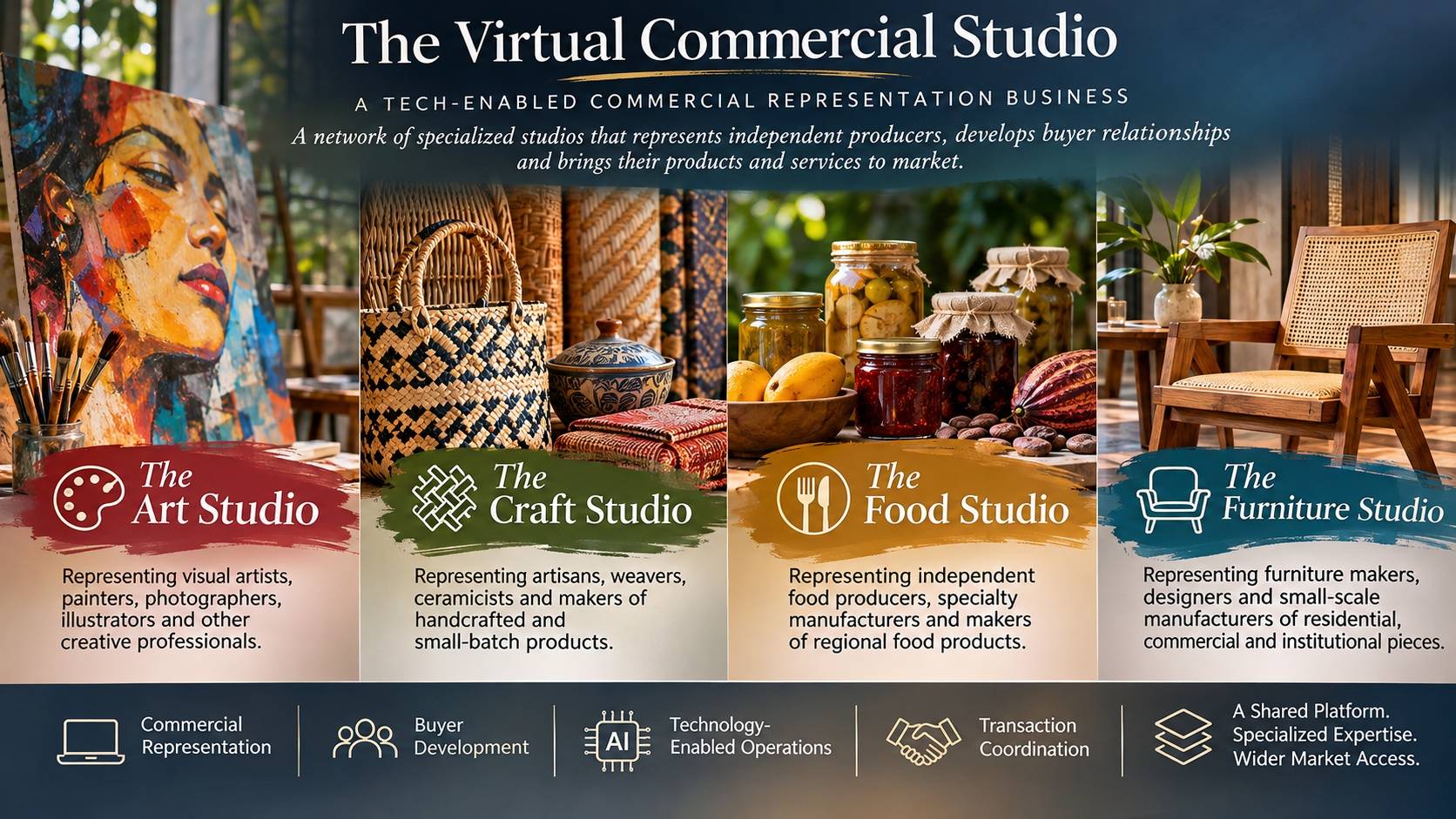
- The Art Studio represents independent painters, photographers and visual artists.
- The Craft Studio represents weavers, artisans, ceramicists and makers of handmade products.
- The Food Studio represents small food manufacturers and specialty food producers.
- The Furniture Studio represents independent furniture makers and designers.
Each specialized studio would have its own identity, brand, producer portfolio and buyer relationships.
They would operate under one parent company, sharing technology, administration, business intelligence and other infrastructure.
The result would be a network of specialized commercial studios without the need to establish a physical office for every division.
What would make it different?
The interesting part isn’t simply putting independent producers together under one company.
It’s the way the business would operate.
Traditional commercial representation relies heavily on people, relationships and sales networks. Those remain important. But technology, particularly artificial intelligence, could change how much a relatively small operation can accomplish.
Imagine a virtual studio with an AI-assisted commercial team.
One system maintains detailed producer profiles, including product specifications, prices, photographs, production capacity and other relevant information.
Another researches prospective buyers, identifies potential markets and looks for opportunities.
A matching system helps determine which producers could meet a buyer’s requirements.
Other AI-assisted processes prepare product presentations, draft proposals, organize inquiries, prepare quotations and manage follow-ups.
Human representatives then concentrate on the work that benefits most from human judgment: building relationships, understanding customer requirements, handling sensitive negotiations and closing agreements.
In time, specialized AI agents could also communicate with authorized buyer and supplier systems, exchange product information and handle routine commercial discussions within agreed boundaries.
The final contractual commitments would remain subject to proper human authorization.
The point is not to replace salespeople with AI.
It’s to give a relatively small commercial team the capacity to represent more producers, reach more buyers and manage more opportunities without having to build a large traditional sales department.
A network, not just a website
The website would be the studio’s public-facing office, catalogue and discovery point.
But the actual business would happen through a much wider network.
It could include in-house sales representatives, independent commission-based agents, industry specialists, referral partners and commercial contacts.
Digital channels would attract prospective buyers, while the human network would actively develop relationships and pursue sales opportunities.
The studio could also work with buyers who have specific sourcing requirements, rather than limiting its activities to products already included in its catalogue.
This is an important distinction.
A marketplace waits for buyers to discover what’s available.
A commercial representation studio can also start with a buyer’s requirements and find the right producer.
How would the business earn?
Several revenue streams are possible:
Sales commissions. The studio earns an agreed percentage of completed sales generated through its representation efforts.
Buyer sourcing fees. Buyers pay for identifying suitable producers and sourcing products that meet their requirements.
Corporate procurement services. The studio charges for managing specialized sourcing assignments or multi-producer requirements.
Additional services. Producers may pay for optional services such as product photography, catalogue preparation, portfolio development and marketing materials.
The actual fees would depend on the industry, transaction size, level of service and commercial arrangement.
The studio would not necessarily own the products, maintain inventory or operate manufacturing facilities. Its principal business would be commercial representation and coordination.
That doesn’t mean the operation would be cost-free. It would still need to invest in producer acquisition, buyer development, technology, personnel, transaction management and quality assurance.
Is this business viable?
That’s the question worth investigating.
There are already businesses operating in related fields. Manufacturers’ representatives, artist agencies, sourcing companies, creative management firms and online marketplaces demonstrate that producers need commercial representation and buyers need access to reliable suppliers.
The challenge is finding out whether these services can be combined into a commercially sustainable operation.
Some questions immediately come to mind:
- Are there enough independent producers willing to pay for professional commercial representation?
- Can the studio consistently generate sales rather than merely attract inquiries?
- Will buyers trust a studio representing multiple independent suppliers?
- How much can AI and automation reduce the cost of sales and customer management?
- Which industries offer sufficient demand, reasonable transaction values and repeat business?
- Can the studio earn enough in commissions and service fees to support its operations?
There are also practical considerations: producer reliability, product quality, delivery commitments, pricing authority, contracts, returns and disputes.
And, of course, technology doesn’t magically solve the problem of finding customers who are willing and able to pay.
A good product still needs a market.
A good sales system still needs buyers.
And a good business model still needs numbers that work.
The bigger possibility
I find this concept interesting because it addresses a gap between production and commerce.
There are people who are very good at making things but not necessarily at selling them. There are buyers who want good products but don’t always know where to find the right producers.
A commercial representation studio could bring these two groups together and take responsibility for making the relationship work.
Technology could make the operation more efficient, expand its reach and reduce some of the costs traditionally associated with maintaining a sales organization.
But its real competitive advantage would come from something that cannot be created simply by installing software: trusted relationships, market knowledge, commercial judgment and the ability to turn opportunities into completed transactions.
The studio doesn’t have to make the product. It has to make the market work.
Perhaps the next interesting business isn’t another company selling products of its own.
Perhaps it’s a company that helps hundreds of independent producers sell theirs.
And that is a business idea worth exploring.
A Note to Readers
This is a business idea worth exploring, not a business guaranteed to succeed.
The concept presented here is exploratory. Its commercial viability would depend on actual market demand, the willingness of producers and buyers to engage with such a service, operating costs, revenue potential and the ability to execute the business model effectively.
As with any business opportunity, research, validation and careful planning are essential before investing time or money.
The purpose of Tita M Wanders’ The Digital Atelier is not to promise success, but to introduce possibilities worth thinking about, questioning and investigating.
An interesting idea is a starting point. What you do with it is another story.
The Digital Atelier
Practical Ideas. Human Ingenuity. Technology That Works.